I used to believe being a good Christian meant strictly following the Bible’s instructions, avoiding sin at all costs, and setting a flawless example to please God and draw others to Him. Then I read the story of Rahab—a woman with a past far from perfect—and realized something life-changing: we are redeemed like Rahab, not because of our perfection, but because of God’s mercy and grace.
Please don’t misunderstand. God wants us to be obedient and let our light shine so others will see His glory. That’s why He gave us the Bible—his love letter. We will have less trouble when we follow the Bible’s instructions. It’s similar to a parent making rules for their children; rules intended to help keep them safe and make good choices. For example, parents instruct their children not to touch a hot stove because they desire to protect them from harm.

But just as parents lovingly forgive their children for disobedience or making mistakes, God gives us grace and mercy. We do not need to be perfect Christians to please God. He already loves us. In His love, God sent Jesus to die for us despite our sins. “But God demonstrates his own love for us in this: While we were still sinners, Christ died for us” (Romans 5:8 NIV).
God did this because He knew that no matter how hard we try to obey his instructions, we are only human. Sometimes, we will fail. But the amazing thing is that God still uses us when we fail, are weak, or even sinful.
My Story
As a young mother, I struggled with anger. My anger stemmed from a need to prove myself, driven by childhood rejection. So, as an adult, I tried to prove my worth by being a perfect mom. I tried to keep my home clean, neat, and organized. I made rigorous schedules and rules. But my quest for perfection led to frustration and tears because children don’t respond to rigor as well as they respond to grace and love.
My anger became a source of guilt and shame. Daily, I would pray and ask God to forgive me. I felt I was letting Him down. I believed I was a bad Christian, and I didn’t deserve God’s love. Worst of all, I began to feel I was such a poor mother that my children would be better off without me.
But God
“But God.” These two beautiful words appear together 45 times in the bible. The following words are always powerful statements and promises about God’s intervention. I felt like a failure. I was drowning in feelings of guilt, weakness, and defeat. But God didn’t give up on me. One day, He showed me this conversation between Paul and God. “But he said to me, ‘My grace is sufficient for you, for my power is made perfect in weakness.’ Therefore I will boast all the more gladly about my weaknesses, so that Christ’s power may rest on me” (2 Corinthians 12:9 NIV).
The Greek word for “sufficient” here is arkei, which implies endurance and strength. Thus, God’s grace strengthens us and gives us endurance when we are weak. Paul directs us to “gladly boast” about our weakness so Christ’s power can dwell in or work through us. Thus, God’s miraculous power becomes evident to all when His good plans come to pass, despite our weakness or sin.
The perfect example of this is the story of Rahab. (Joshua 2–6).
Rahab’s Story
Rahab was a Canaanite prostitute living in Jericho. Canaanites were idol worshipers who believed in the god Ashtaroth, the goddess of the moon. Jericho was a fortified city directly in the path of the Israelites as they advanced toward the promised land.
After the Israelites crossed the Jordan River, Joshua sent two spies to scout out the land west of the Jordan. Because of God’s plan, the two spies ended up at Rahab’s door. Rahab risked her own life and hid them on her roof rather than turn them over to the authorities. She did this because she had heard how God saved the Israelites. So, despite her culture’s beliefs, Rahab believed in God.
Next, Rahab helped the spies escape through her window, which was located in the city wall. She instructed them to hide in the hills for three days to avoid capture. Then, she hung a scarlet cord from her window to distinguish her home and signify that her family was inside. In exchange, the Israelites passed over her house and spared them when they conquered Jericho. God used the scarlet cord to symbolize both the past and future: the Passover and the future blood of Jesus. Talk about a divine plan.
Finally, Rahab married an Israelite named Salmon and had a son named Boaz. Boaz later became the husband of Ruth, the grandmother of King David in the lineage of Jesus (Matthew 1:1-17).
What Can We Learn From Rahab’s Story?
Rahab’s story demonstrates that everyone has value to God. Rahab was a sinner, a prostitute, who society rejected and scorned. She was not an Israelite but an outsider from a pagan culture. Yet God still offered her grace and mercy, saving her life and that of her family. Despite her past weakness and sin, God used her in his divine plan for His people to gain the promised land.
Rahab’s story also demonstrates that our faith determines our future rather than our past mistakes and sins. Rahab believed in God’s promise of protection and acted on her faith at grave risk to herself. God rewarded Rahab’s faith with a future marriage, grafting her into Jesus’s lineage. The Bible honors Rahab for her faith and bravery and lists her in Hebrews 11 as what has become known as the “Faith Hall of Fame.”
We Are Redeemed Like Rahab
In a way, Jesus was like Rahab. Jesus’ culture rejected Him because He didn’t fulfill their expectations that the Messiah would save the Jews by overthrowing the Roman Empire. The Jewish leaders didn’t believe in Him and saw Him as a threat to their power. Yet despite being perfect, never once sinning, Jesus was crucified for blasphemy.
However, what others viewed as defeat, being nailed to a cross, became Jesus’ most significant victory because it was part of God’s perfect plan for our redemption. “For all have sinned and fall short of the glory of God, and all are justified freely by his grace through the redemption that came by Christ Jesus. God presented Christ as a sacrifice of atonement, through the shedding of his blood—to be received by faith. He did this to demonstrate his righteousness, because in his forbearance he had left the sins committed beforehand unpunished” (Romans 3:23-25, NIV).
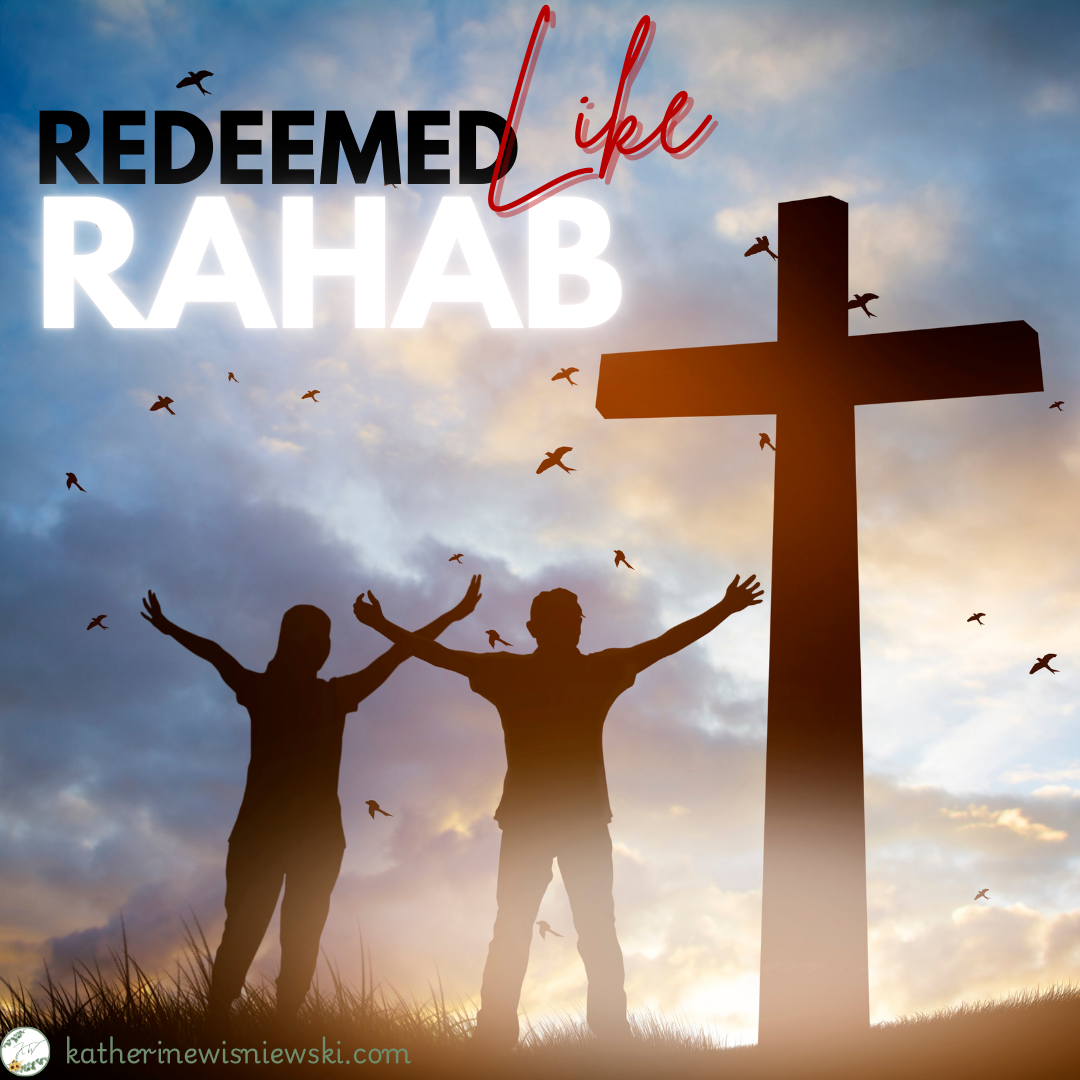
So, friend, we are redeemed like Rahab. Just as God redeemed and rewarded Rahab because of her faith, God redeems us and rewards our faith with salvation, forgiveness, and the righteousness of Christ.
Redeemed Like Rahab—What It Means for Our Lives
As I stated earlier, God wants us to follow his directions. But, friend, God knows we are only human. We can remember that we are redeemed like Rahab because Jesus died for us despite our sins. In so doing, Jesus gave us His righteousness. “God made him who had no sin to be sin for us, so that in him we might become the righteousness of God” (2 Corinthians 5:21, NIV).
When we mess up, all we have to do is ask God for forgiveness and repent. Jesus said, “ I have not come to call the righteous but sinners to repentance” (Luke 5:32, ESV). “If we confess our sins, he is faithful and just to forgive us our sins and to cleanse us from all unrighteousness.” (1 John 1:9, ESV).
You might have noticed I said, “repent.” Repenting means turning away from our sins. We do not have full rein to keep sinning because God forgives us. “What shall we say, then? Shall we go on sinning so that grace may increase? By no means!” (Romans 6:1-2, NIV).
But, friend, here’s the best part: Jesus sent the Holy Spirit to help us be obedient and strengthen us when we are weak. Jesus said, “But the Advocate, the Holy Spirit, whom the Father will send in my name, will teach you all things and will remind you of everything I have said to you” (John 14:26, NIV). When we walk by the Spirit, He helps us refrain from gratifying the desires of our flesh (Galatians 5:16).
Application Of Being Redeemed Like Rahab

Rahab’s story reminds us that God loves us no matter who we are or how badly we mess up. We are redeemed like Rahab!
So, friend, we can stop focusing on our failures and start focusing on the Father. Sin and weakness will never keep God from loving or using us in His glorious plans. So, let’s lift our eyes to Him and seek forgiveness, strength, and wisdom. God will guide and help us overcome our sins through His Holy Spirit. Like Rahab, let’s be willing to step out in faith and join God in His plans, remembering that God rewards faithfulness, not flawlessness.
More Reading About God’s Grace And Overcoming Sin
Psalm 34: A Song of Praise And Promise